



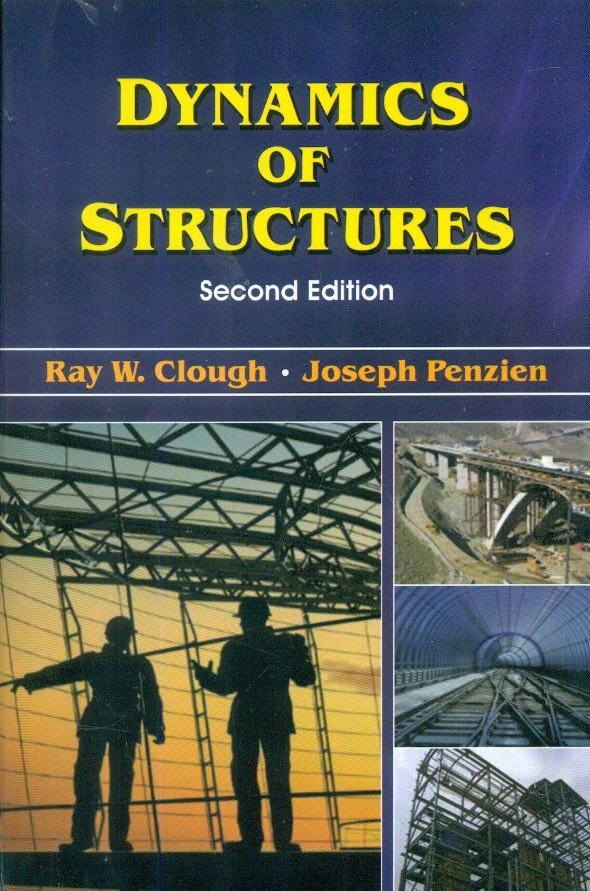
The general organization of text material remains unchanged from the first edition. It progresses logically from a treatment of single-degree-of-freedom systems to multi-degree-of-freedom discrete-parameter systems and then on to infinite-degree-of-freedom continuous systems. The concept of force equilibrium, which forms the basis of static analysis of structures, is retained so that the experienced engineer can easily make the transition to performing a dynamic analysis. It is essential therefore that the student of structural dynamics have a solid background in the theories of statics of structures, including matrix methods, and it is assumed that the readers of this text have such preparation. The theoretical treatment in Parts I, II, and III is deterministic in nature because it makes use of dynamic loadings which are fully prescribed even though they may be highly irregular and transient with respect to time. The treatment of random vibrations in Part IV is however stochastic (random) in form since the loadings considered can be characterized only in a statistical manner. An understanding of basic probability theory is therefore an essential prerequisite to the study of this subject. Before proceeding with this study, it is recommended that the student take a full course on probability theory; however, if this has not been done, the brief treatment of probability concepts given in Chapter 20 can serve as minimum preparation. The solution of a typical structural dynamics problem is considerably more complicated than its static counterpart due to the addition-of inertia and damping to the elastic resistance forces and due to the time dependency of all force quantities. For most practical situations, the solution usually is possible only through the use of a high-speed digital computer, which has become the standard tool of the structural dynamicist.


24 Support
+91 1234567890

Clinical Chemistry Concepts And Applications :
-20%₹985.00 ₹788.00

Petrography Of Igneous And Metamorphic Rocks : With Cd-Rom (Pb 2015)
-20%₹697.50 ₹558.00





















Reviews
There are no reviews yet.